
Background and Targets
The local authority led Superfast Northamptonshire project and the government’s Project Gigabit are investing in broadband infrastructure in areas of market failure i.e. localities where commercial telecoms investment is unlikely to come forward, leaving properties in need of public intervention to secure much needed uplifts in broadband speeds.
With over 99% of Northamptonshire premises now able to access superfast broadband, the focus is now on delivery of future proof technologies, namely full fibre and gigabit capable network infrastructure.
Background
The internet is a vital tool for information, communication, learning, healthcare, enterprise and entertainment alike – ensuring access to reliable high-speed performance is becoming ever more in demand and essential for modern life.
At the inception of the Superfast Northamptonshire project in 2011, full fibre coverage was less than 0.5% of premises in the county and less than 60% of premises had access to superfast speeds (≥30Mbps). Predicted commercial telecoms plans were unlikely to take coverage beyond 75% – action was needed to avoid tens of thousands of homes being left without decent broadband. The project’s focus initially was to boost the availability of superfast broadband and largely delivered fibre-based technologies (part fibre part copper Fibre to the Cabinet (FTTC) technology) – with some full fibre coverage where economical to do so. FTTC was ideal for providing a much-needed speed uplift to high volumes of premises in a relatively short time, whilst constrained by an upper access line speed of 80Mbps for those properties closest to the cabinet.
The Authority chose to invest in gigabit infrastructure for the final stage of the Superfast project, ahead of the government’s Project Gigabit, recognising the future would bring ever increasing demands on data and the need for a step change in broadband speed.
Inviting a strong market
Promoting both North and West Northamptonshire as great places for commercial investment by telecoms providers is important to realising local ambitions. Attracting the interest of telecoms providers aims to maximise commercial coverage without the need for public funding. It also increases competition, encourages innovation, and provides choice for end users. This approach has been successful with several new fibre network providers investing significantly in the county since the start of the Superfast Northamptonshire project back in 2011. A list of the known commercial fibre suppliers in Northamptonshire can be found on the Telecoms Providers page.
Public intervention where needed
Network delivery on a commercial basis by telecoms providers is not viable everywhere. Places which fall outside of commercial plans are the focus for public investment.
At the outset of the UK digital infrastructure programmes, the government’s focus was on enabling more widespread superfast broadband coverage. This meant minimum download speeds of over 24Mbps (since defined as ≥30Mbps). When we launched the Superfast Northamptonshire project, only 60% of premises in the county had access to superfast broadband and only 0.4% of premises had full fibre. Forecast commercial plans were only likely to extend coverage to around 75% of premises. Public intervention was needed to boost access to superfast broadband and secure widespread availability.
The intervention area to invest public funding is determined through an Open Market Review. This is a consultation with telecoms providers to determine their current coverage and future plans. The outcome of the OMR informs a State Aid Public Consultation which confirms the intended intervention area and secures clearance from the UK Competence Centre to invest public funding in broadband networks. This clearance process is to ensure there is no distortion of the market.
This process was undertaken in 2012, 2014 and 2015/16 for the purpose of Stages 1, 2 and 3 of the Superfast Northamptonshire project. The most recent local State Aid Public Consultation was completed in April 2021. You can find out more on the State Aid Public Consultation web page. Government agency, Building Digital UK (BDUK), now undertake regular national OMR’s to inform areas for intervention through Project Gigabit.
Local broadband targets
Digital technologies have advanced more rapidly than any innovation in history. Early local authority intervention from 2011, with government, to support superfast broadband (≥ 30Mbps) has been crucial for the economy by enabling widespread availability of digital technology which can enhance business performance and efficiency. It is also supporting home working, leisure, health care and environmental benefits, and access to learning. Digital connectivity needs were brought into sharp focus with the COVID-19 pandemic and outlooks have changed.
Digital creativity and technology innovation is driving ever increasing consumption of broadband capability and our local ambition recognises that full fibre and gigabit capable technology is crucial for future prosperity – and it’s unlikely to end there.
Locally set broadband coverage targets have been ambitious throughout the Superfast programme and Northamptonshire has consistently performed well in comparison to coverage levels in England overall. The Superfast Northamptonshire project and local targets have remained countywide since North and West Northamptonshire Councils were established in March 2021. With performance exceeding expectations, new targets are now being considered.
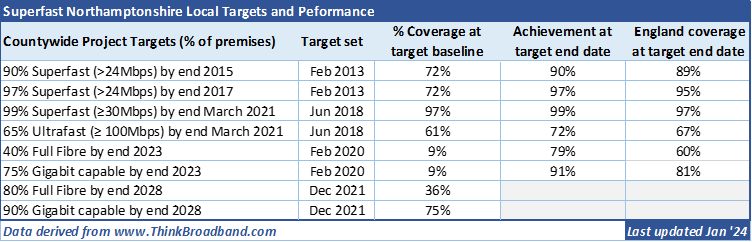
Government Policy Targets
In 2010, the UK Government set out its vision for the UK to have the best superfast broadband network in Europe. It launched the Superfast Broadband Programme with £530m of public funding, and with the aim of extending superfast coverage to 90% of UK premises by the end of 2016 and 95% by the end of 2017. This was in response to concerns that the commercial roll out of superfast broadband infrastructure would fail to reach many parts of the UK. These targets were adopted and met in Northamptonshire. Indeed, by the end of 2017, local superfast coverage had reached 97%, outperforming national ambitions.
In 2017, the government published a UK Digital Strategy addressing the main milestones for future broadband development throughout the UK, along with a Next Generation Mobile Technologies 5G Strategy. Together these set out an ambition to create a world leading digital economy in the UK. In July 2018, government published the outcome of its Future Telecoms Infrastructure Review. This set out a national, long-term strategy for digital connectivity, including more stretching targets for 15 million premises to be connected to full fibre by 2025, with nationwide coverage by 2033. Government has since moved away from a full fibre target.
A £5 billion digital infrastructure programme was announced by the government in its 2019 Manifesto. Project Gigabit followed.
Current government targets are to achieve a minimum of 85% gigabit capable broadband coverage across the UK by 2025 and for coverage to reach nationwide by 2030 (at least 99% of premises).
Better Broadband Scheme
As part of Stage 1 of the Superfast Northamptonshire project, there was also a commitment to see basic broadband services of at least 2Mbps available to all premises. As part of a national programme, a Better Broadband subsidy scheme was launched locally in December 2015. It closed in December 2019. This provided people who were suffering the lowest broadband speeds in the county (below 2Mbps) with the opportunity to take up faster services offered by a range of registered providers. Solutions were largely reliant on satellite broadband technology.
The Superfast Northamptonshire project is working with suppliers to ensure that Northamptonshire is one of the best places (urban and rural) in the country for fast and reliable broadband connectivity. You can keep up to date on project progress on the Coverage Progres page.